Dreaming: Annemirl Bauer and Bärbel Bohley
Annemirl Bauer and Bärbel Bohley
23 Sep–8 Nov 26
Opening: 23 Sep 26, 6 pm
Featuring artworks by Annemirl Bauer and Bärbel Bohley in conversation with photographs by Christian Borchert, Jürgen Graetz and Barbara Klemm
Curated by Sandra Teitge and Susanne Weiß
„If there’s anyone who should have been here to see the wall fall, it’s Annemirl. Because she had such a sense of wanderlust […] her whole life, she really was like a bird flapping its wings against its cage.” Bärbel Bohley
The exhibition “Dreaming” unravels the relationship between two unusual personalities and political voices: Annemirl Bauer and Bärbel Bohley. Both considered themselves artists and political activists. They routinely defied the political regime, which punished and degraded them repeatedly. Both were mothers and dreamed of a better socialism. Author Christa Wolf put this feeling into words on 4 November 1989: “So we dream, rationally and wide awake.”
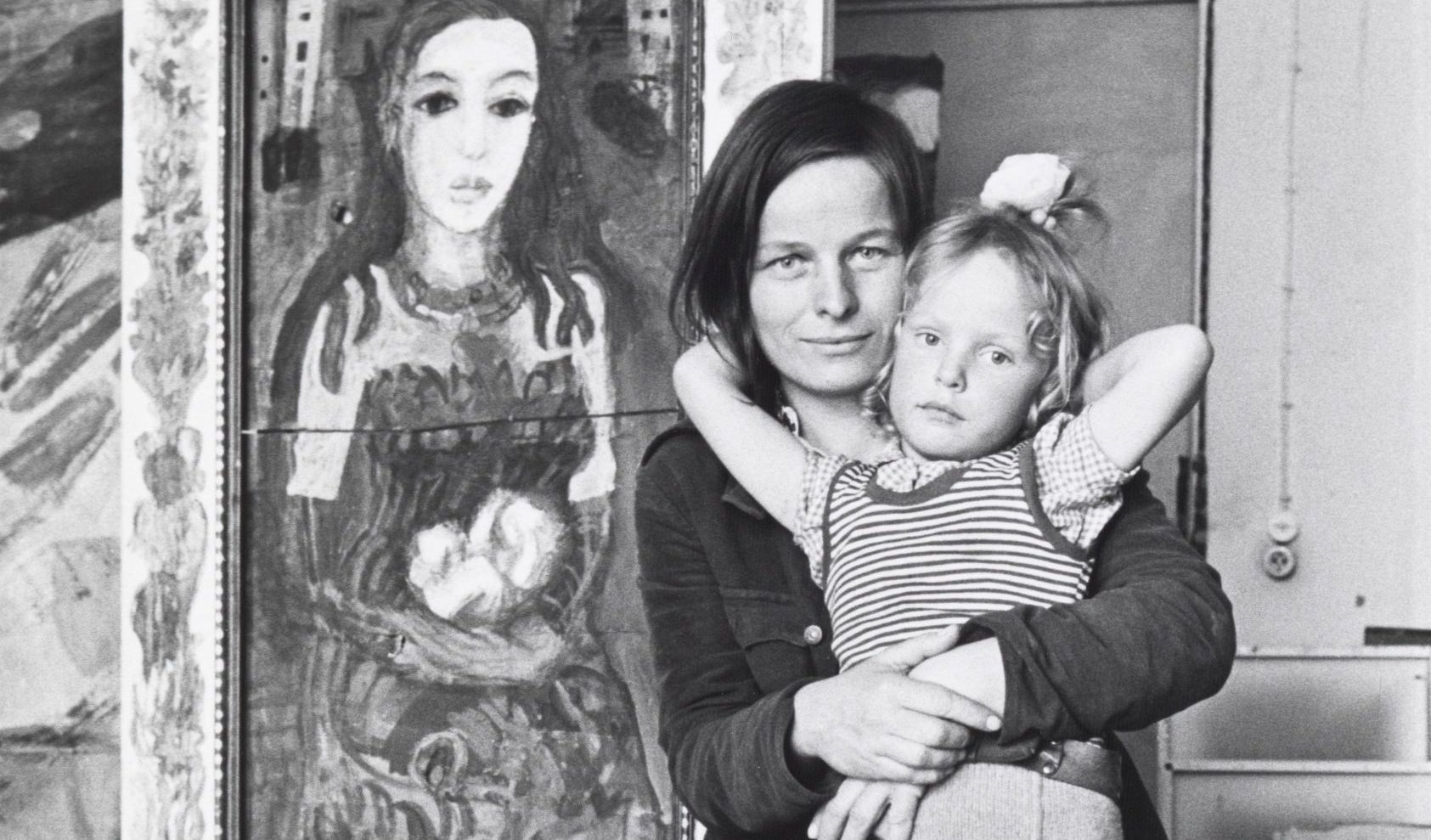
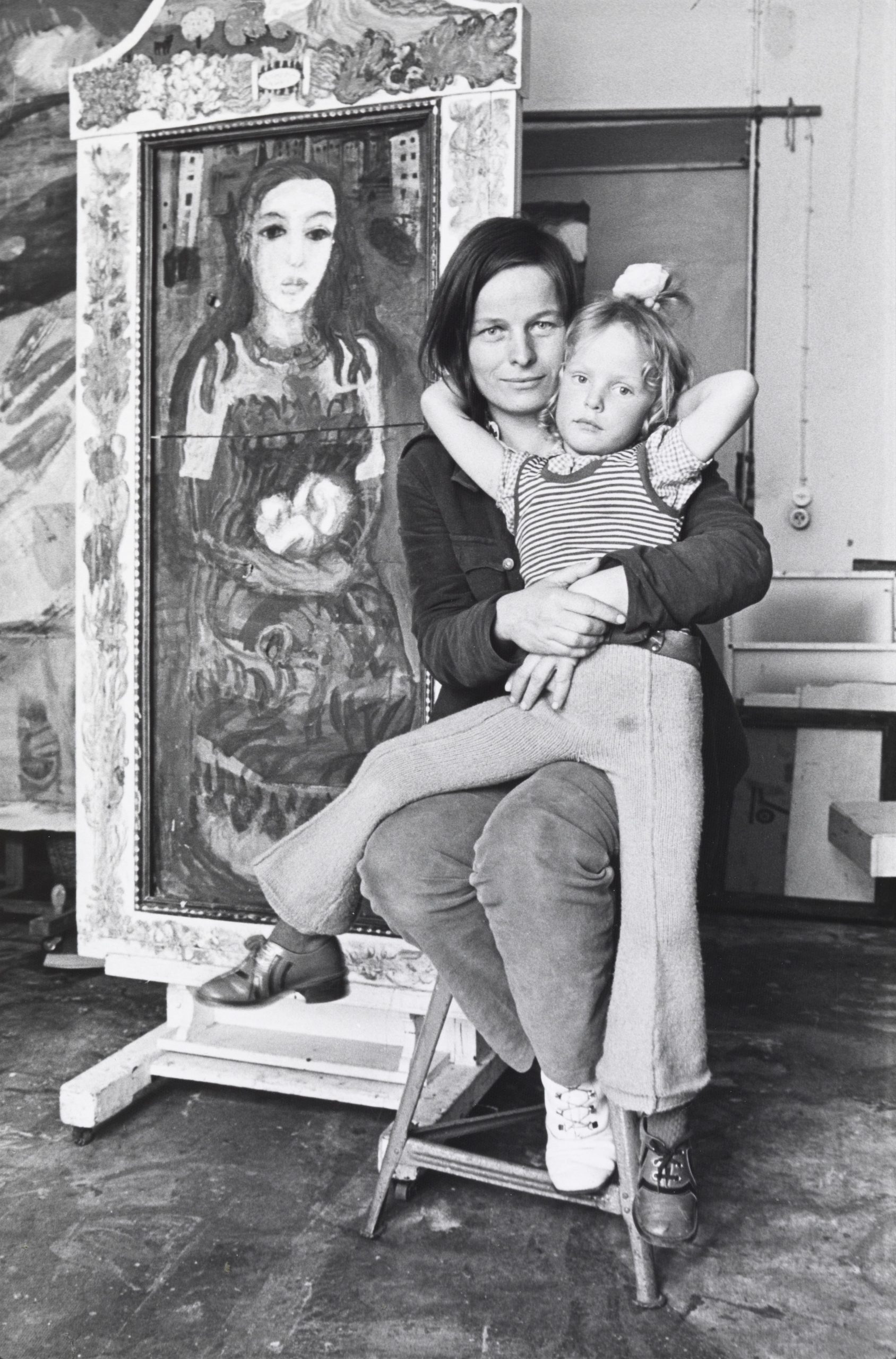
“Dreaming: Annemirl Bauer and Bärbel Bohley” begins with a portrait of Annemirl Bauer together with her daughter Amrei, taken by Christian Borchert at her studio in Berlin’s Prenzlauer Berg in 1975 – a moving testament to the connection between mother, daughter and art. Borchert’s portfolio from the collection of the Centre for Art Exhibitions of the GDR (Zentrum für Kunstausstellungen der DDR or ZfK) documents iconic facets of East Germany’s art scene and poses questions about visibility and exclusion: Who received support, who was shut out? The ZfK worked together closely with the GDR’s Association of Visual Artists ((Verband Bildender Künstler der DDR or VBK). The Association was highly significant in the careers of East German artists – being excluded from it was effectively a professional ban.
Annemirl Bauer’s artwork is closely intertwined with her autobiography. Born in Jena in 1939, she began her training as a ceramicist and toy designer at a young age. Whenever possible, she travelled – to France, Bulgaria, Spain and Czechoslovakia. After her second trip to France, she enrolled at university, where she completed her degree in 1964. As a graduate of an Art Academy, she was automatically a member of the Artists’ Association. Bauer soon became a critical voice against the GDR’s dogmatic art system. As a single mother, she lived in precarity and was a victim of the Stasi’s so-called Zersetzungsmaßnahmen, or the methods of psychological warfare employed against political dissidents. Her artwork incorporates colourful, figurative realism into expressive, unmediated drawings. She painted and drew constantly on various surfaces, producing portraits of numerous colleagues including Bärbel Bohley – who defended Bauer when the VBK attempted to oust her, and became active in the VBK herself.
Bauer repeatedly protested the GDR’s travel restrictions and the draft for women. In 1984, she openly pushed for all travel restrictions to be lifted, which led the Stasi to sanction her with a professional ban and further repressive measures. She died of cancer at the age of 50, just before the fall of the Berlin Wall in 1989. Bohley stepped away from art for good that same year. She responded to a request for a print with the line, “Sometimes, art is absent!” – her final gesture as an artist. From then on, she was active as a politician in the New Forum at the East German “Round Table”, or the process of peaceful revolution that ultimately led to the GDR’s dissolution and Germany’s reunification. This role brought her national recognition. The idea of bringing people together at one table to initiate change can be viewed as her true artwork. Bohley’s work spans prints, drawings and paintings that focus on human beings – the individual as part of a group, or isolated from it. This is her way of placing the communist ideology, according to which a single person flourishes as part of a collective, in opposition to the individual.
The ZfK’s collection does not include any of Bauer’s artworks and only a select few of Bohleys; neither ever held an exhibition at Galerie im Turm. Founded in 1965, the gallery at Berlin’s Frankfurter Tor was closely connected to the VBK. “Dreaming: Annemirl Bauer and Bärbel Bohley” seeks to close this gap and amend the chapter of history that intentionally excluded these artists, honouring their defiant work. In 2010 a public square was named after Annemirl Bauer; Bärbel Bohley has yet to be officially recognised as a visual artist.
The Publik Machen project by the ifa – Institut für Auslandsbeziehungen is presented in cooperation with the Wüstenrot Foundation.
The five-part Berlin exhibition series Publik Machen by the ifa – Institut für Auslandsbeziehungen is being realized in cooperation with the Wüstenrot Foundation and in collaboration with Schloss Biesdorf, the Kunstverein Ost (KVOST), the Prater Galerie, and the Galerie im Turm, and is supported by the Hauptstadtkulturfonds (HKF).
The exhibition “Produktive Unruhe” by the Kunsthaus Dresden/robotron Kantine and the ifa – Institut für Auslandsbeziehungen is being realized in cooperation with the Wüstenrot Foundation and is supported by the Kunstfonds Bonn, the Kulturstiftung des Freistaates Sachsen, the Stiftung Kunst und Musik and the Volker Hohmann Stiftung.
The six-part exhibition series Making Public: On the Work and Legacy of the Centre for Art Exhibitions of the GDR is a cooperation of the ifa – Institut für Auslandsbeziehungen (ifa) with the Kunsthaus Dresden and five Berlin institutions. The comprehensive research project examines the work and legacy of the Centre for Art Exhibitions of the GDR (Zentrum für Kunstausstellungen der DDR or ZfK). An institution that, to date, has received little attention, the ZfK played a unique role in the German Democratic Republic’s (GDR) artworld – in part because it was under the authority of the Ministry of Culture and developed its programme in accordance with the state’s cultural policy agenda, and in part because it was established to improve East Germany’s standing abroad and promote cultural exchange around the world.
Founded in 1973, the institution was marked by a new liberal spirit of “breadth and diversity” in cultural policy – an attitude also reflected in its collection of artworks, which included an assortment of prints transferred to the ifa in 1991. After thirty years in relative obscurity, the ZfK’s collection now constitutes the core of the six exhibition projects presented here. The artworks were housed either in portfolios of the GDR’s Association of Visual Artists (Verband Bildender Künstler der DDR or VBK) or were acquired to be shown in specific exhibitions. In this sense, the ZfK functioned both as patron and gatekeeper. It showcased international art within the GDR, and, more frequently, presented artwork from the GDR abroad. The institution offered artists opportunities to travel to destinations significant to East German cultural policy and featured the resulting work in exhibitions.
The ifa has been researching the ZfK’s work and history in cooperation with the Wüstenrot Foundation (Wüstenrot Stiftung) since 2023. In early 2024, artistic director Susanne Weiß initiated a working group to examine the ZfK’s trajectory and legacy that consisted of artists Anna Bromley, David Polzin and Suse Weber, curators Thibaut de Ruyter and Sandra Teitge as well as filmmaker Sylvie Kürsten. Making Public builds on their ongoing research at the German Federal Archives and the Akademie der Künste as well as their conversations with historic witnesses. In the resulting artistic research projects, Anna Bromley, David Polzin and Suse Weber provide historical context for art production in the GDR, illuminating archival materials that deepen contemporary understandings of the period and provoke questions about the relationship between art and the state.
Artworks from the ZfK’s and the ifa’s historical collections are the exhibitions’ second key focus, while the presentation at the Kunsthaus Dresden explores the ninth and tenth Art Exhibitions of the GDR – large-scale national exhibitions organized by the ZfK from their former headquarters in Dresden. Featured artists from the ZfK holdings include HAP Grieshaber, Charlotte Elfriede Pauly, Elizabeth Shaw, Erika Stürmer-Alex, Hans Ticha, and Karla Woisnitza, among many others. Individual exhibitions organised by the ZfK also came to represent significant points of reference. Thibaut de Ruyter’s Coda: Reenacting an Exhibition draws on the ZfK’s touring exhibition “Musik in der bildenden Kunst der DDR” (Music in Visual Art from the GDR), which travelled from Paris to Vienna and stopped in Bucharest as well as Duisburg, among other cities, between 1983 and 1986.
Team
Curation: Sandra Teitge and Susanne Weiß (ifa)
Production: Carolina Redondo
With the support of Carlotta Gonindard Liebe, Director of Galerie im Turm

Making Public: On the Work and Legacy of the Centre for Art Exhibitions of the GDR. An exhibition by the ifa in cooperation with the Wüstenrot Stiftung. The exhibition series in Berlin is supported by the Hauptstadtkulturfonds (HKF).